
Joint statement by the IUGS and ICS on the vote by the ICS Subcommission on Quaternary Stratigraphy
It is with the delegated authority of the IUGS President and Secretary General and on behalf of the International Commission on Stratigraphy (ICS) that the vote by the ICS Subcommission on Quaternary Stratigraphy (SQS) to reject the proposal for an Anthropocene Epoch as a formal unit of the Geologic Time Scale is approved. March 26 2024.
Legacy site
Below details the past activities of the Anthropocene Working Group, a former working group of the SQS.
Formal proposal of the Anthropocene Working Group to the Subcommission on Quaternary Stratigraphy – 31st October 2023
The formal report of the Anthropocene Working Group (AWG) proposes that a Crawfordian Stage/Age and Anthropocene Series/Epoch should be part of the International Chronostratigraphic Chart (ICC), with its base at a level representing 1952 CE, marking a sharp upturn in plutonium levels as the primary marker and more generally aligned with the historical phase of the mid-twentieth century ‘Great Acceleration’.
The proposed GSSP is found in a varved succession of lake sediment from Crawford Lake, Ontario, Canada. Three Standard Auxiliary Boundary Stratotypes (SABS) are also proposed; from Beppu Bay, Japan, Sihailongwan Maar Lake, China and Śnieźka peatland, Poland.
The proposals submitted by the AWG to the SQS can be downloaded from EarthArXiv
Executive Summary: The Anthropocene Epoch and Crawfordian Age https://eartharxiv.org/repository/view/6853/ (doi: https://doi.org/10.31223/X5VH70)
Part 1: Anthropocene Series/Epoch: stratigraphic context and justification of rank https://eartharxiv.org/repository/view/6954/ (doi: https://doi.org/10.31223/X5MQ3C)
Part 2: Descriptions of the proposed Crawford Lake GSSP and supporting SABSs https://eartharxiv.org/repository/view/6963/ (doi:https://doi.org/10.31223/X5RD71)
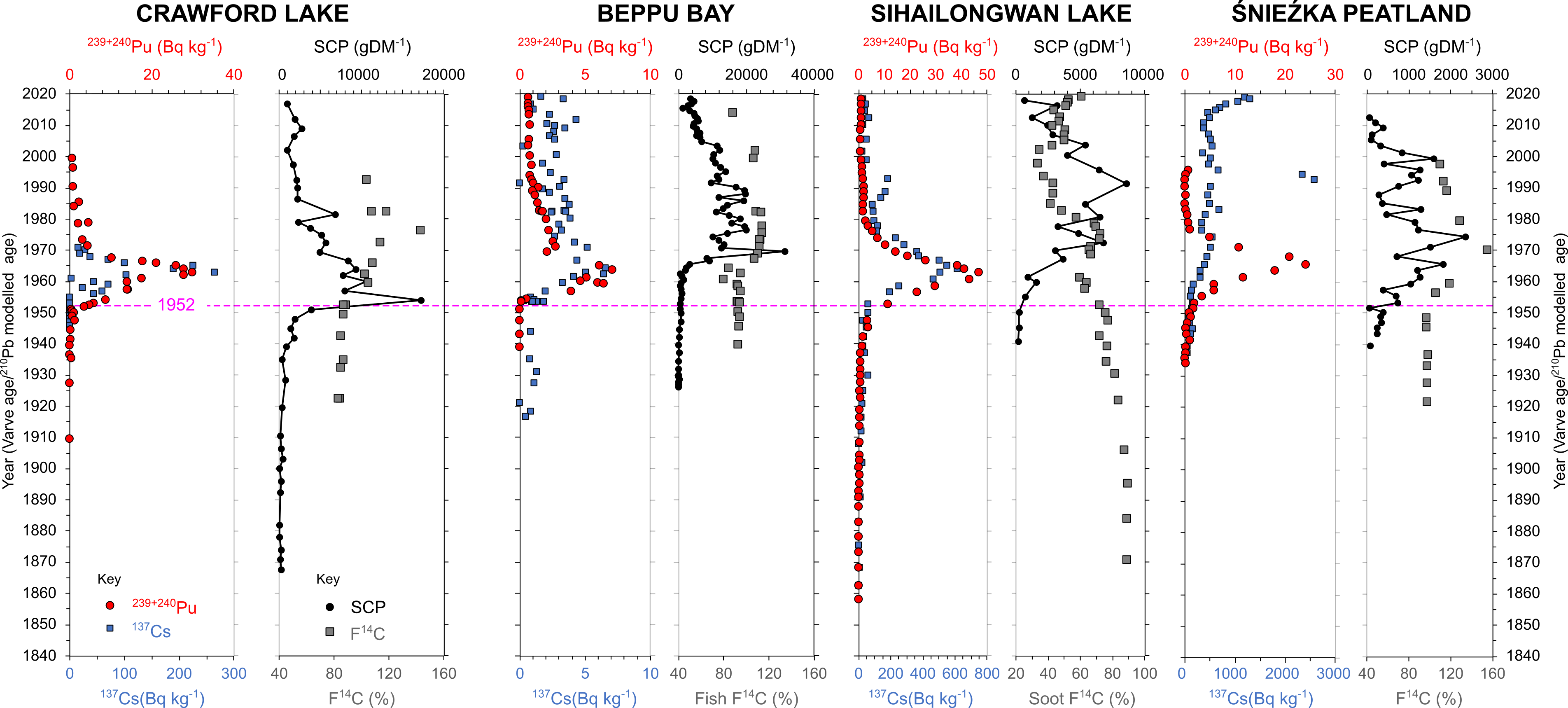
Correlation of primary marker (239+240Pu) and selected additional markers (spheroidal carbonaceous particles (SCPs), caesium (137Cs) and radiocarbon (F14C) between proposed Anthropocene GSSP at Crawford Lake and the three SABSs of Beppu Bay, Sihailongwan Maar Lake and Śnieżka Peatland relative to the 1952 CE onset of the Anthropocene.
(Source: Figure ES3 in Executive Summary)
Further details on the stratigraphic research from the sites investigated by the AWG and GSSP scientific teams can be found in the special issue of The Anthropocene Review. “Global boundary Stratotype Section and Point for the Anthropocene series”, Volume 10, Issue 1, April 2023 https://journals.sagepub.com/toc/anra/10/1
Thank you to all the teams of scientists who contributed to this chronostratigraphic research and the great numbers of scholars and wider community globally who have jointly explored the Anthropocene since 2009. Special thanks to the Haus der Kulturen der Welt and Max Planck Institute for the History of Science who supported this unique, collaborative, and transdisciplinary exploration of the Anthropocene with the AWG between 2014 and 2022.
Results of binding vote by AWG
Released 21st May 2019
Following guidance from the Subcommission on Quaternary Stratigraphy and the International Commission on Stratigraphy, the AWG have completed a binding vote to affirm some of the key questions that were voted on and agreed at the IGC Cape Town meeting in 2016. The details are as follows:
No. of potential voting members: 34 No. required to be quorate (60%): 21 No. of votes received: 33 (97% of voting membership)
Q1. Should the Anthropocene be treated as a formal chrono-stratigraphic unit defined by a GSSP?
29 voted in favour (88% of votes cast); 4 voted against; no abstentions
Q2. Should the primary guide for the base of the Anthropocene be one of the stratigraphic signals around the mid-twentieth century of the Common Era?
29 voted in favour (88% of votes cast); 4 voted against; no abstentions
Both votes exceed the 60% supermajority of cast votes required to be agreed by the Anthropocene Working Group as the official stance of the group and will guide their subsequent analysis.
What is the Anthropocene? – current definition and status
- The ‘Anthropocene’ is a term widely used since its coining by Paul Crutzen and Eugene Stoermer in 2000 to denote the present geological time interval, in which many conditions and processes on Earth are profoundly altered by human impact. This impact has intensified significantly since the onset of industrialization, taking us out of the Earth System state typical of the Holocene Epoch that post-dates the last glaciation.
- The ‘Anthropocene’ has developed a range of meanings among vastly different scholarly communities. Here we examine the Anthropocene as a geological time (chronostratigraphic) unit and potential addition to the Geological Time Scale, consistent with Crutzen and Stoermer’s original proposal. The Anthropocene Working Group (AWG) is charged with this task as a component body of the Subcommission on Quaternary Stratigraphy (SQS) which is itself a constituent body of the International Commission on Stratigraphy (ICS).
- Phenomena associated with the Anthropocene include: an order-of-magnitude increase in erosion and sediment transport associated with urbanization and agriculture; marked and abrupt anthropogenic perturbations of the cycles of elements such as carbon, nitrogen, phosphorus and various metals together with new chemical compounds; environmental changes generated by these perturbations, including global warming, sea-level rise, ocean acidification and spreading oceanic ‘dead zones’; rapid changes in the biosphere both on land and in the sea, as a result of habitat loss, predation, explosion of domestic animal populations and species invasions; and the proliferation and global dispersion of many new ‘minerals’ and ‘rocks’ including concrete, fly ash and plastics, and the myriad ‘technofossils’ produced from these and other materials.
- Many of these changes will persist for millennia or longer, and are altering the trajectory of the Earth System, some with permanent effect. They are being reflected in a distinctive body of geological strata now accumulating, with potential to be preserved into the far future.
- The Anthropocene is not currently a formally defined geological unit within the Geological Time Scale; officially we still live within the Meghalayan Age of the Holocene Epoch. A proposal to formalise the Anthropocene is being developed by the AWG. Based on preliminary recommendations made by the AWG in 2016, this proposal is being developed on the following basis:
- It is being considered at series/epoch level (and so its base/beginning would terminate the Holocene Series/Epoch as well as Meghalayan Stage/Age);
- It would be defined by the standard means for a unit of the Geological Time Scale, via a Global boundary Stratotype Section and Point (GSSP), colloquially known as a ‘golden spike’;
- Its beginning would be optimally placed in the mid-20th century, coinciding with the array of geological proxy signals preserved within recently accumulated strata and resulting from the ‘Great Acceleration’ of population growth, industrialization and globalization;
- The sharpest and most globally synchronous of these signals, that may form a primary marker, is made by the artificial radionuclides spread worldwide by the thermonuclear bomb tests from the early 1950s.
Analyses of potential ‘golden spike’ locations are underway. The resultant proposal, when made, would need supermajority (>60%) agreement by the AWG and its parent bodies (successively the SQS and ICS) and ratification by the Executive Committee of the International Union of Geological Sciences. The success of any such proposal is not guaranteed.
- Broadly, to be accepted as a formal geological time term the Anthropocene needs to be (a) scientifically justified, i.e. the ‘geological signal’ currently being produced in strata now forming must be significantly large, clear and distinctive; sufficient evidence has now been gathered to demonstrate this phenomenon (b) useful as a formal term to the scientific community. In terms of (b), the currently informal term ‘Anthropocene’ has already proven highly useful to the global change and Earth System science research communities and thus will continue to be used. Its value as a formal geological time term to other communities continues to be discussed.
- The Anthropocene has emerged as a popular scientific term used by scientists, the scientifically engaged public and the media to designate the period of Earth’s history during which humans have a decisive influence on the state, dynamics and future of the Earth System. It is widely agreed that the Earth is currently in such a state. The term has also been used in a non-chronostratigraphic context to be an informal term to denote a broader interpretation of anthropogenic impact on the planet that is markedly diachronous, reaching back many millennia. In geology, such an interpretation is already encompassed by lithostratigraphy, in which the character of stratified rocks is based solely on their physical features and not by age. Such an interpretation represents a concept sharply distinct from the Anthropocene as a chronostratigraphic unit, though it can be complementary with it.
Working group convenors:
Colin Waters (Chair) e-mail: cw398@leicester.ac.uk
Simon Turner (Secretary) e-mail: simon.turner@ucl.ac.uk
Members (v, voting members):
An Zhisheng e-mail: anzs@loess.llqg.ac.cn
Anthony Barnosky (v) e-mail: tonybarnosky@stanford.edu
Alejandro Cearreta (v) e-mail: alejandro.cearreta@ehu.eus
Andy Cundy (v) e-mail: A.Cundy@noc.soton.ac.uk
Ian Fairchild (v) e-mail: i.j.fairchild@bham.ac.uk
Barbara Fiałkiewicz-Koziel (v) e-mail: barbara.fiałkiewicz-koziel
Agnieszka Gałuszka (v) e-mail: aggie@ujk.edu.pl
Jacques Grinevald e-mail: jacques.grinevald@graduateinstitute.ch
Irka Hajdas (v) e-mail: hajdas@phys.ethz.ch
Han Yongming (v) e-mail: yongming@ieecas.cn
Martin J. Head (v) (Vice-Chair, SQS) email: mjhead@brocku.ca
Juliana Assunção Ivar do Sul email: juliana.ivardosul@io-warnemuende.de
Catherine Jeandel e-mail: catherine.jeandel@legos.obs-mip.fr
Reinhold Leinfelder (v) e-mail: reinhold.leinfelder@fu-berlin.de
Francine McCarthy (v) e-mail: fmccarthy@brocku.ca
John McNeill e-mail: mcneillj@georgetown.edu
Eric Odada e-mail: eodada@uonbi.ac.ke
Naomi Oreskes e-mail: oreskes@fas.harvard.edu
Clément Poirier e-mail: clement.poirier@unicaen.fr
Dan Richter e-mail drichter@duke.edu
Neil Rose (v) e-mail: n.rose@ucl.ac.uk
Yoshiki Saito (v) e-mail: ysaito@soc.shimane-u.ac.jp
Bill Shotyk e-mail: shotyk@ualberta.ca
Colin Summerhayes (v) e-mail: cps32@cam.ac.uk
Jaia Syvitski (v) e-mail: jai.syvitski@colorado.edu
Simon Turner (v) (AWG Secretary) e-mail: simon.turner@ucl.ac.uk
Davor Vidas e-mail: dvidas@fni.no
Michael Wagreich (v) e-mail: michael.wagreich@univie.ac.at
Colin Waters (v) (AWG Chair) e-mail: cw398@leicester.ac.uk
Mark Williams (v) e-mail: mri@leicester.ac.uk
Scott Wing (v) e-mail: wings@si.edu
Jan Zalasiewicz (v) (Chair, SQS) e-mail: jaz1@leicester.ac.uk
Jens Zinke (v) e-mail: jz262@leicester.ac.uk
Working Group communications:
Publications of the Working Group on the ‘Anthropocene’
2023
-
-
-
-
- Head, M.J., Waters, C.N., Zalasiewicz, J.A., Barnosky, A.D., Turner, S.D., Cearreta, A., Leinfelder, R., McCarthy, F.M.G., Richter, D. de B., Rose, N.L., Saito, Y., Vidas, D., Wagreich, M., Han, Y., Summerhayes, C.P., Williams, M. & Zinke, J. (2023). The Anthropocene as an epoch is distinct from all other concepts known by this term: a reply to Swindles et al. (2023). Journal of Quaternary Science, 38, 455–458. https://doi.org/10.1002/jqs.3513
- Head, M.J., Zalasiewicz, J.A., Waters, C.N., Turner, S.D., Williams, M., Barnosky, A.D., Steffen, W., Wagreich, M., Haff, P.K., Syvitski, J., Leinfelder, R., McCarthy, F.M.G., Rose, N.L., Wing, S.L., An, Z., Cearreta, A., Cundy, A.B., Fairchild, I.J., Han, Y., Sul, J.A.I. do, Jeandel, C., McNeill, J.R. & Summerhayes, C.P. (2023). The Anthropocene is a prospective epoch/series, not a geological event. Episodes, 46, 229–238. https://doi.org/10.18814/epiiugs/2022/022025
- Waters, C.N., Head, M.J., Zalasiewicz, J., McCarthy, F.M.G., Wing, S.L., Haff, P.K., Williams, M., Barnosky, A.D., Fiałkiewicz-Kozieł, B., Leinfelder, R., McNeill, J.R., Rose, N.L., Steffen, W., Summerhayes, C.P., Wagreich, M., An, Z., Cearreta, A., Cundy, A.B., Fairchild, I.J., Gałuszka, A., Hajdas, I., Han, Y., Ivar do Sul, J.A., Jeandel, C., Syvitski, J., Turner, S.D. & Zinke, J. (2023). Response to Merritts et al. (2023): The Anthropocene is complex. Defining it is not. Earth-Science Reviews, 238, 104335. https://doi.org/10.1016/j.earscirev.2023.104335
- Zalasiewicz, J., Head, M.J., Waters, C.N., Turner, S.D., Haff, P.K., Summerhayes, C., Williams, M., Cearreta, A., Wagreich, M., Fairchild, I., Rose, N.L., Saito, Y., Leinfelder, R., Fiałkiewicz-Kozieł, B., An, Z., Syvitski, J., Gałuszka, A., McCarthy, F.M.G., Ivar do Sul, J., Barnosky, A., Cundy, A.B., McNeill, J.R. & Zinke, J. (2023). The Anthropocene within the Geological Time Scale: a response to fundamental questions. Episodes, https://doi.org/10.18814/epiiugs/2023/023025
-
-
-
2022
-
-
-
-
- Gibbard, P., Walker, M., Bauer, A., Edgeworth, M., Edwards, L., Ellis, E., Finney, S., Gill, J.L., Maslin, M., Merritts, D. and Ruddiman, W., 2022. The Anthropocene as an Event, not an Epoch. Journal of Quaternary Science, 37(3): 395–399. https://doi.org/10.1002/jqs.3416
- Head, M.J., Zalasiewicz, J.A., Waters, C.N., Turner, S.D., Williams, M., Barnosky, A.D., Steffen, W., Wagreich, M., Haff, P.K., Syvitski, J., Leinfelder, R., McCarthy, F.M.G., Rose, N.L., Wing, S.L., An, Z., Cearetta, A., Cundy, A., B., Fairchild, I.J., Han, Y., Ivar do Sul, J.A., Jeandel, C., McNeill, J.R. and Summerhayes, C.P (2022). The proposed Anthropocene Epoch/Series is underpinned by an extensive array of mid-20th century stratigraphic event signals. Journal of Quaternary Science, 37(7), 1181-1187. https://doi.org/10.1002/jqs.3467
- Head, M.J. Zalasiewicz, J.A., Waters, C.N., Turner, S.D., Williams, M., Barnosky, A.D., Steffen, W., Wagreich, M., Haff, P.K., Syvitski, J., Leinfelder, R., McCarthy, F.M.G., Neil Rose, N.L., Wing, S.L. An, Z., Cearreta, A., Cundy, A.B., Fairchild, I.J., Han, Y., Ivar do Sul, J.A., Jeandel, C., McNeill, J.R. and Summerhayes, C.P. (2022) The Anthropocene is a prospective epoch/series, not a geological event. IUGS Episodes. https://doi.org/10.18814/epiiugs/2022/022025
- Waters, C.N., Williams, M., Zalasiewicz, J., Turner, S.D., Barnosky, A.D., Head, M.J.,, Wing, S.I., Wagreich, M., Steffen, W., Summerhayes, C.P., Cundy, A.B., Zinke, J., Failkiewicz-Koziel, B., Leinholder, R., Haff, P.K., McNeill, J.R., Rose, N.L., Hajdas, K., McCarthy, F.M.G., Cearreta, A., Galuszka, A., Syvitski, J., Han, Y., An, Z., Fairchild, I.J., Ivar do Sul, J.A. and Jeandel, C. (2022) Epochs, events and episodes: Marking the geological impact of humans. Earth-Science Reviews, https://doi.org/10.1016/j.earscirev.2022.104171
- Williams, M., Leinfelder, R., Barnosky, A.D., Head, M.J., McCarthy, F.M., Cearreta, A., Himson, S., Holmes, R., Waters, C.N., Zalasiewicz, J., Turner, S. et al. (2022). Planetary‐scale change to the biosphere signalled by global species translocations can be used to identify the Anthropocene. Palaeontology, 65(4), p.e12618. doi: 10.1111/pala.12618
-
-
-
2021
-
-
-
-
- Bauer, A.M., Edgeworth, M., Edwards, L.E., Ellis, E.C., Gibbard, P. and Merritts, D.J., (2021). Anthropocene: event or epoch?. Nature, 597(7876), pp.332-332. https://doi.org/10.1038/d41586-021-02448-z
- Gibbard, P.L., Bauer, A.M., Edgeworth, M., Ruddiman, W.F., Gill, J.L., Merritts, D.J., Finney, S.C., Edwards, L.E., Walker, M.J.C., Maslin, M. and Ellis, E.C. (2021). A practical solution: the Anthropocene is a geological event, not a formal epoch. Episodes, https://doi.org/10.18814/epiiugs/2021/021029
- Head, M.J., Steffen, W., Fagerlind, D., Waters, C.N., Poirier, C., Syvitski, J., Zalasiewicz, J.A., Barnosky, A.D., Cearreta, A., Jeandel, C., Leinfelder, R., McNeill, J.R., Rose, N.L., Summerhayes, C., Wagreich, M. and Zinke, J. (2021). The Great Acceleration is real and provides a quantitative basis for the proposed Anthropocene Series/Epoch. Episodes. https://doi.org/10.18814/epiiugs/2021/021031
- Zalasiewicz, J., Waters, C. N., Ellis, E. C., Head, M. J., Vidas, D., Steffen, W., Thomas, J. A., Horn, E., Summerhayes, C. P., Leinfelder, R., McNeill, J. R., Gałuszka, A., Williams, M., Barnosky, A. D., Richter, D. deB., Gibbard, P. L., Syvitski, J., Jeandel, C., Cearreta, A., Cundy, A. B., Fairchild, I. J., Rose, N. L., Ivar do Sul, J. A., Shotyk, W., Turner, S., Wagreich, M., and Zinke, J. (2021). The Anthropocene: comparing its meaning in geology (chronostratigraphy) with conceptual approaches arising in other disciplines. Earth’s Future, 9(3), e2020EF001782 https://doi.org/10.1029/2020EF001896
-
-
-
2020
-
-
-
-
- Syvitski, J., Waters, C.N., Day, J., Milliman, J.D., Summerhayes, C., Steffen, W., Zalasiewicz, J., Cearreta, A., Gałuszka, A., Hajdas, I., Head, M.J., Leinfelder, R., McNeill, J.R., Poirier, C., Rose, N.L., Shotyk, W., Wagreich, M., Williams, M., 2020. Extraordinary human energy consumption and resultant geological impacts beginning around 1950 CE initiated the proposed Anthropocene Epoch. Communications Earth & Environment, 1:32, https://doi.org/10.1038/s43247-020-00029-y
- Zalasiewicz, J., Waters, C. and Williams, M. (2020). Chapter 31: The Anthropocene. In: Gradstein, F., Ogg, J., Schmitz, M. and Ogg, G. (eds.) A Geologic Time Scale 2020, 1257-1280.
-
-
-
2019
-
-
-
-
- Williams, M. et al. 2019. Underground metro systems: a durable geological proxy of rapid urban population growth and energy consumption during the Anthropocene. In Craig Benjamin, Esther Quaedakers and David Baker (Eds.) Anthropocene: The Routledge Handbook of Big History (Routledge Companions). Oxon: Taylor & Francis.
- Zalasiewicz, J., Gabbott, S.E. and Waters C.N. 2019. Chapter 23: Plastic Waste: how plastic has become part of the Earth’s geological cycle. In: Trevor M. Letcher and Dan A Vallero (eds.) Waste: A Handbook for Management, 2nd edition. Elsevier, New York, 443-452.
- Zalasiewicz, J. et al. 2019. A formal Anthropocene is compatible with but distinct from its diachronous anthropogenic counterparts: a response to WF Ruddiman’s ‘three flaws in defining a formal Anthropocene’. Progress in Physical Geography, 43(3): 319-333.
- Zalasiewicz, J, Waters, CN et al. (Eds.) (2019). The Anthropocene as a Geological Time Unit. CUP.
 The Anthropocene, a term launched into public debate by Nobel Prize winner Paul Crutzen, has been used informally to describe the time interval during which human actions have had a drastic effect on the Earth and its ecosystems, including anthropogenic climate change. This book presents the underpinning geological evidence for defining the Anthropocene as a geological epoch, written by the high-profile international team tasked with analysing its potential addition to the Geological Time Scale. It discusses Anthropocene stratigraphy and ongoing changes to the Earth system, including the climate, oceans and biosphere.
The evidence for the Anthropocene is examined in detail, ranging from chemical signals arising from pollution, to physical changes to the landscape associated with urbanisation and biological changes associated with species invasion and extinctions. The scale, manner and rate of global environmental change is placed within the context of planetary processes and deep geological time, allowing the reader to appreciate the scale of human-driven change to the Earth system, and compare the global transition taking place today with major transitions in Earth history. Key aspects of the geological background are explained, providing an authoritative review of the Anthropocene for graduate students and academic researchers across a broad range of scientific, social science and humanities disciplines.
-
-
-
2018
-
-
-
-
- Cooper, Anthony H.et al. 2018 Humans are the most significant global geomorphological driving force of the 21st Century.Anthropocene Review. 1-8.
- Summerhayes, C. and Zalsiewicz, J. 2018. Global warming and the Anthropocene. Geology Today, 34(5): 194-200.
- Waters, C N. et al. 2018. A Global Boundary Stratotype Sections and Points (GSSPs) for the Anthropocene Series: Where and how to look for a potential candidate. Earth-Sci. Rev., 178, 379-429.
- Waters, C N. et al. 2018. How to date natural archives of the Anthropocene. Geology Today, 34(5):182-187.
- Waters, C N. and Zalasiewicz, J. 2018. Concrete: the most abundant novel rock type of the Anthropocene. In Dominick A. DellaSala and Michael I. Goldstein (Eds.), The Encyclopedia of the Anthropocene: Vol. 1 (75-85). Oxford: Elsevier.
- Williams, M. et al. 2018. The palaeontological record of the Anthropocene. Geology Today, 24(5): 188-193.
- Zalasiewicz, J. et al. 2018. The Anthropocene. Geology Today, 34(5): 177-181.
- Zalasiewicz, J. et al. 2018. The stratigraphical signature of the Anthropocene in England and its wider context. Proceedings of the Geologists’ Association, 129(3): 482-491.
- Zalasiewicz, J, and Waters, C N. 2018. Arguments for an official Global Stratotype Section and Point for the Anthropocene. In Dominick A. DellaSala and Michael I. Goldstein (Eds.) The Encyclopedia of the Anthropocene: Vol. 1 (29-34). Oxford: Elsevier.
-
-
-
2017
-
-
-
-
- Grinevald, J. et al. 2017. Les preuves jusifiant une nouvelle période géologique ne manquent pas. La Recherche, 520: 87-88.
- Williams, M., Zalasiewicz, J. and Waters, C N. 2017. The Anthropocene: a geological perspective. In Heikkurinen, P. (Ed.), Sustainability and Peaceful Coexistence for the Anthropocene. Oxon: Taylor & Francis.
- Zalasiewicz, J., Waters, C N. and Williams, M. 2017. Les strates de la ville de l’Anthropocène. Annels, Histoire, Sciences Sociales, 72(2): 329-351.
- Zalasiewicz, J, Waters, CN & Head, MJ 2017. Anthropocene: its stratigraphic basis. Nature, 541 (7637): 289.
- Zalasiewicz, J, Waters, CN et al. 2017. Making the case for a formal Anthropocene Epoch: an analysis of ongoing critiques. Newsletters on Stratigraphy, 50(2): 205-226.
- Zalasiewicz, J, Williams, M, Waters, CN et al. 2017. Scale and diversity of the physical technosphere: a geological perspective. Rev., 4(1): 9-22.
- Zalasiewicz, J. et al. 2017. The geological and Earth System reality of the Anthropocene: Reply to Bauer and Ellis. Current Anthropology, 59(2): 220-223.
- Zalasiewicz, J. et al. 2017. The Working Group on the ‘Anthropocene’: Summary of evidence and recommendations. Anthropocene 19: 55-60.
-
-
-
2016
-
-
-
-
- Edgeworth, M. et al. 2016. Second Anthropocene Working Group Meeting (Conference Report). The European Archaeologist 47.
- Steffen, W, Leinfelder, R, Zalasiewicz, J, Waters, CN et al. 2016. Stratigraphic and Earth System Approaches to Defining the Anthropocene. Earth’s Future. DOI: 10.1002/2016EF000379.
- Waters, CN et al. 2016. The Anthropocene is functionally and stratigraphically distinct from the Holocene. Science, 351 (6269): 137.
- Williams, M. et al. The Anthropocene: a conspicuous stratigraphical signal of anthropogenic changes in production and consumption across the biosphere. Earth’s Future 4(3): 34-53.
- Zalasiewicz, J., Waters, CN et al. 2016. The geological cycle of plastics and their use as a stratigraphic indicator of the Anthropocene. Anthropocene, 13: 4-17.
- Zalasiewicz, J., Williams, M. and Waters, C N. 2016. Anthropocene. In Joni Adamson, William A. Gleason, and David N. Pellow (Eds.) Keywords in the Study of Environment and Culture (14-16). New York: NYU Press.
- Zalasiewicz, J. et al. 2016. Petrifying earth process: the stratigraphic imprint of key earth parameters in the Anthropocene. Theory, Culture & Society, 34(2-3): 83-104.
- Zalasiewics, J. et al. 2016 Scale and diversity of the physical technosphere: a geological perspective. The Anthropocene Review, 4(1): 9-22.
-
-
-
2015
-
-
-
-
- Edgeworth, M, Richter, D DeB, Waters, CN et al. Diachronous beginnings of the Anthropocene: The lower bounding surface of anthropogenic deposits. Anth. Rev. 2(1): 1-26.
- Waters, CN et al. 2015. Can nuclear weapons fallout mark the beginning of the Anthropocene Epoch? Atom. Sci., 71(3): 46-57.
- Zalasiewicz, J, Waters, CN et al. Colonization of the Americas, ‘Little Ice Age’ climate, and bomb-produced carbon: Their role in defining the Anthropocene. Anth. Rev., 2(2): 117-127.
- Zalasiewicz, J, Waters, CN et al. When did the Anthropocene begin? A mid-twentieth century boundary level is stratigraphically optimal. Quat. Int., 383: 196-203.
- Zalasiewicz, J. and Waters, C N. 2015. The Anthropocene. Oxford Research Encyclopedia of Environmental Science. Framing Concepts in Environmental Science.
-
-
-
2014
-
-
-
-
- Waters, CN et al. 2014. A Stratigraphical basis for the Anthropocene. Geological Society, London, Special Publication, 395, 321pp.
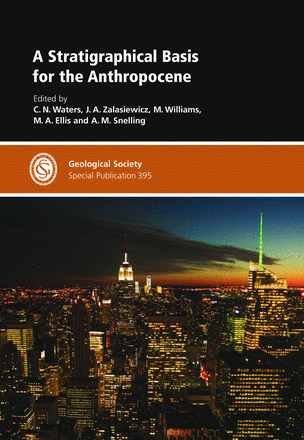
- Zalasiewicz, J, Waters, CN & Williams, M 2014. Human bioturbation, and the subterranean landscape of the Anthropocene. Anthropocene, 6: 3-9.
- Zalasiewicz, J, Williams, M, Waters, CN et al. 2014. The technofossil records of humans. Rev., 1(1), 34-43.
- Waters, CN et al. 2014. A Stratigraphical basis for the Anthropocene. Geological Society, London, Special Publication, 395, 321pp.
-
-
-
2011
-
-
-
-
- Williams, M et al. (Eds.) 2011. Theme issue ‘The Anthropocene: a new epoch of geological time?’ Philosophical Transactions of the Royal Society A 369(1938).
- Williams, M et al. (Eds.) 2011. Theme issue ‘The Anthropocene: a new epoch of geological time?’ Philosophical Transactions of the Royal Society A 369(1938).
-
-
-
2008
-
-
-
-
- Zalasiewicz, J, Williams, M, Smith, A, Barry, TL, Coe, AL, Bown, PR, Brenchley, P, Cantrill, D, Gale, A, Gibbard, P, Gregory, FJ, Hounslow, MW, Kerr, AC, Pearson, P, Knox, R, Powell, JH, Waters, CN et al. 2008. Are we living in the Anthropocene? GSA Today, 18(2): 4-8.
-
-
-
2007
-
-
-
-
- Steffen, W et al. 2007. The Anthropocene: Are Humans Now Overwhelming the Great Forces of Nature? Ambio 36(8): 614-621.
-
-
-
2002
-
-
-
-
- Crutzen, P.J. 2002. Geology of Mankind. Nature 415(6867), 23.
-
-
-
2000
-
-
-
-
- Crutzen, P.J. & Stoermer, E.F. 2000. The “Anthropocene”. Global Change Newsletter 41: 17-18.
-
-
-